
* The best destinations of Yunnan: Kungming, Dali, Lijiang, Shangri-La;
* Discover the natural beauty of Yunnan: Stone Forest, Tiger Leaping Gorge, Napahai Lake, go hiking to search for the beauty of nature, etc;
* Explore the ethnic groups in Yunnan: Yi, Bai, Naxi, Tibetan, etc;
* Enjoy the real life of local people in the ancient towns and villages: Sibeihou Village, Dali Old Town, Xizhou Old Town, Zhoucheng Village, Yuhu village, Lijiang Old Town, Baisha Old Town, Dukezong Old Town;
* Visit the landmark temple and monastery: Jizhaoan Monastery, Songzanlin Monastery;
* Visit some local culture, such as: Tie-dye in Zhoucheng, Naxi embroidery in Baisha, Thangka Painting etc;
* Experience bullet train from Kunming to Dali;
Kunming Changshui International Airport
3 Hours Before Flight Time
FRI Arrival in Kunming. Meet your guide at airport and transfer to hotel.
The capital of Yunnan Province, Kunming is one of China’s noted historical and cultural cities. The city is located in central Yunnan at the elevation of 1894 meters above sea level and is praised as the city of eternal spring. Rest of day at leisure.
Lunch and dinner at leisure.
Overnight at Weilong Hotel (or similar) ****
SAT Buffet breakfast at hotel.
Drive along the new express way to Stone Forest. Stone Forest (eco-bus incl.) is 89 kilometers from Kunming and is accessible by a bus ride of 90 minutes. The Stone forest belongs to the typical Karst geomorphology, it consists of innumerable bizarre-shaped ancient limestone cliffs and peaks created by wind and water erosion some 200 million years ago, and this area is praised as the “First Wonder under Heaven”.
After lunch, visit a local Yi Ethnic Group Village—Sibeihou Village(寺背后村).
Drive back to Kunming visit the Green Lake Park in the afternoon, Green Lake Park is the biggest park in the city proper of Kunming. Attractions in the neighborhood of Green Lake Park include the former Yunnan military Academy History Museum, believed to be the biggest quadrangle building of China, and you will see people in Kunming enjoying their leisure life in the afternoon. If time and weather permit, you could learn to write Chinese Calligraphy using water and over-size brush writing on the ground in the Green Lake Park (14:00-17:00). Or if it rains, we will adjust to visit Yunnan Military Academy History Museum (Jiangwutang).
Lunch at local restaurant, dinner at leisure.
Overnight at Weilong Hotel (or similar) ****
SUN Buffet breakfast at hotel.
After breakfast, your guide and driver will pick you to the Kunming Train Station and take a bullet train to Dali. Upon arrival in Dali, proceed to visit the Three Pagodas (eco-bus excl.), and then visit the Er’hai Ecological Corridor Road (eco-bus excl.) and then stroll in Dali Old Town (eco-bus excl.).
Standing against the Cangshan Mountains in the west and adjoining the Erhai Lake in the east, embraced by undulating hills around, Dali was the capital of Nanzhao and Dali Kingdom as early as 1,300 years ago, it is home to Bai minority.
Standing in a way of a tripod on the outskirts of old town, the Three Pagodas were constructed in about 850 and 1050 following the model of the Small Wild Goose Pagoda in Xi’an. For centuries, they are considered landmark of the region.
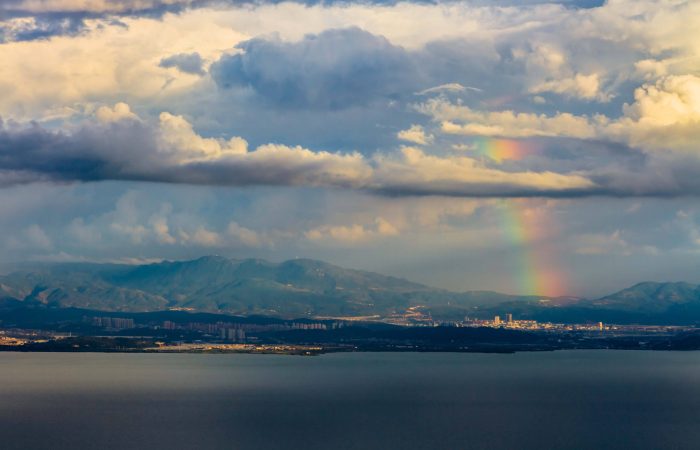
The Er’hai Lake located at the eastern foot of the Cangshan Mountain, is a fault basin. It is the second largest plateau freshwater lake with the reputation of “Plateau Pearl”. It is a famous scenic spot, as well as Dali’s main source of drinking water. Now, the ecological corridor along Erhai Lake attracts tourists from all over the world. The 129-kilometer corridor safeguards the environment of Erhai Lake while providing ecological dividends to locals who protect it.
The Dali Old Town of weathered gray granite stands at 2,100 meters on a long, narrow rice plain between the Cangshan Mountains and the Erhai Lake, a natural configuration that seems specially designed for a good, bountiful life. Format of the old town is like a chessboard with four gates guarding in the directions of east, south, west and north, a design that was adopted by most towns in ancient China.
Lunch at local restaurant, dinner at leisure.
Overnight at Dali Landscape Hotel (or similar) ****
MON Buffet breakfast at hotel.
In the morning, overland drive of 180 kilometers, or 3 hours, along the new highway to Lijiang. Visit the Bai village Xizhou, Bai Minority Tie-dye Cloth in Zhoucheng Village, Shaping Monday Market (07:00a.m.-12:00p.m.) on the way. P.S. After the tour in Dali, the Dali local guide will finish the service, Lijiang local guide will wait the group in Lijiang.
23 kilometers north of Dali, Xizhou village has a more mixed population and cosmopolitan background. It grew and flourished in the Ming Dynasty (1368-1644) along with the fortunes of Dali’s renowned tea merchants that traded to Tibet. Family Yan’s Courtyard is a good example of traditional Bai houses. And each morning, villagers in Bai dresses gather in a small market to buy and sell their produce and daily wares.
Visit traditional hand-made Tie Dyeing Cloth in one of the local Bai people’s house in Zhoucheng.
And then visit Shaping Market, is a local market on every Monday. The local people come to the market from surrounding villages to exchange their daily wares, farming products, traditional clothes, or simply foods and vegetables.
Upon arrival in Lijiang, lunch first, after that, you will visit Lijiang Ancient Town and Sifang Square.
And then check in your hotel.
A gathering place of rugged mountain people with the Naxi forming the majority, Lijiang is a small mountain town of stone and tile, laced with swift canals, which was enlisted as an UNESCO World Cultural Heritage in 1999. Lijiang Ancient Town is a big area with its center, or Si Fang Jie (Square Street) in the form of an official ink stone, hence its name Dayan (ink stone) Old Town. It enjoys a long history of over 800 years and unlike most of the old towns in China, there is no city walls due to a superstitious belief of the local ruler whose family name is Mu (tree), when encircled by walls, would be Kun (besieged).
Lunch at local Chinese restaurant, dinner at leisure.
Overnight at Lijiang JP HYLLIS Hotel (or similar) ****
TUE Buffet breakfast at hotel.
Drive to visit Baisha Ancient Town, visit Naxi embroidery in a local institution.
Then visit the Yuhu Village, a simple village of Naxi minority with the former residence of Dr. Joseph Rock. Dr. Rock, an Austro-American botanist and explorer who lived here off and on from 1922-1949, is best remembered for the introduction of innumerable plant species to the West and his rigorous works on Naxi ethnology. (If clients don’t want to visit the former residence of Dr. Joseph Rock.).
Then drive back to visit Zhongyi Local Market, Black Dragon Pool and Dongba Museum.
At the north end of old town, the Black Dragon Pool, surrounded by walkways, willow and chestnut trees, is the best known and most frequently visited park in Lijiang. The Five Phoenix Pavilion built in early 17th century possesses intricately joined, beautifully painted eaves. The three-storeyed Moon Embracing Pavilion is a serene, beautifully proportioned structure. The Dongba Museum was founded in 1981 in a purpose to study, document and preserve the ancient Naxi culture of the dongbas, religious shamans who played a pivotal role in traditional society.
Rest of day at leisure.
Lunch at local Chinese restaurant, dinner at leisure.
Overnight at Lijiang JP HYLLIS Hote (or similar) ****
WED Buffet breakfast at hotel.
After breakfast, leave for Lijiang this morning with guide. The drive takes about 4 hours, and you will have a chance to see the breathtaking scenery along the way.
P.S. Lijiang local guide will escort the group to Qiaotou Township and meet with the Shangri-la local guide. The Lijiang local guide finish the service, the Shangri-la guide will take guests on a hike and the rest of the trip.
First, you will see the First Bend of the Yangtze River and take some photos on the way. A sudden V-shaped bend has been formed here when the Yangtze River flowing by, hence the name.
Then, visit Tiger Leaping Gorge (lift excl.), which is one of the deepest and most beautiful gorges in China. The water current is very fast here as the river is surrounded by high peaks, steep cliffs and jagged rocks.
After that, drive to Halfway guesthouse have a lunch, after lunch, since here trekking on Upper-Tiger Leaping Gorge for around 2 hours to Tina’s guesthouse.
And then, go ahead driving to Shangri-la, you will visit Xiaozhongdian Grassland on the way stops for half an hour.
Arrive at Shangri-la in the late afternoon, check in your hotel.
Lunch at local Chinese restaurant, dinner at leisure.
Overnight at Floral·Shangri-la Lefugedan Inn (or similar) ****
THU Buffet breakfast at hotel.
Visit Ganden Songzanlin Monastery (eco-bus incl.) in the morning. Songzanlin Monastery, the biggest monastery in Zhongdian, is built on a hill immitating the Potala Palace in Lhasa. More than 500 lamas live and study here.
And then, visit a Tibetan family where the Tibetan builds their houses by wood with big sitting room and Buddhism hall,
try the home-made buttered tea and yak cheese.
After lunch, drive back to Intangible Cultural Heritage Museum and experience to paint Thangka.
Thangka is a unique painting art form in Tibetan culture. With distinctive national characteristics, rich religious color and unique artistic style, it depicts the sacred world of Buddha with bright color. Known as the treasure of Chinese national painting art, known as the Tibetan “Encyclopedia”, it is also a precious intangible cultural heritage in Chinese folk art. If you want to describe what kind of art Thangka is, in addition to its internal cultural expression, it should be a kind of delicate and delicate art, sharpening the inner peace and quiet, a trace of exquisite outline, not a trace of deviation, without long years of persistence. The process of drawing and accepting Thangka is the process of converting to Buddhism, the process of accumulating good deeds, the process of spiritual baptism and purification, and the process of shaping and cultivating personality.(Visit + painting time 2 hours, you can take yourself to mount and hang at home.)
And then, discover Dukezong Ancient Town – the largest and best-preserved Tibetan population in China and also a very important station along the Tea-Horse Road. Besides, walking up to the top of Guishan Hill to appreciate the typical Tibetan style view – Prayer Wheel.
Lunch at local Chinese restaurant, dinner at leisure.
Overnight at Floral·Shangri-la Lefugedan Inn (or similar) ****
FRI Buffet breakfast at hotel.
Check out the hotel before 12:00
Service ends.